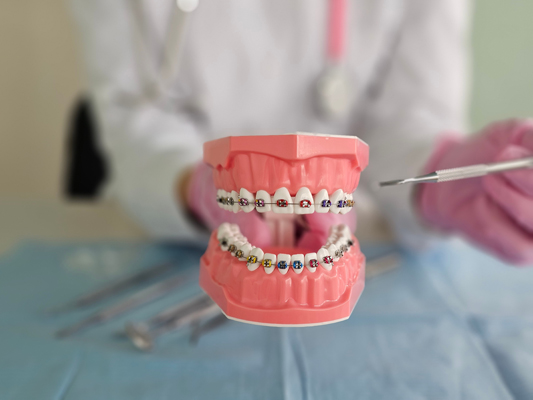
Braces are one of the oldest devices used to straighten teeth in dentistry. They work by applying constant force on teeth, slowly improving their alignment over time. Braces consist of brackets, wires, and elastic used to connect both dental arcs.
Metal braces are the oldest form of braces, and they have been around for a couple of centuries. These devices come with brackets and wires made from metal alloys. They are the most durable type of braces and are often recommended for those with severe teeth alignment issues.
Metal braces are highly visible appliances, leading to less visible alternatives like ceramic braces being developed. These devices swap the metal components of traditional braces with more aesthetically pleasing tooth-colored or transparent brackets and wires.
Braces stay in the patient’s mouth once placed for the duration of their treatment, which can be anywhere between 12 to 36 months. Dentists often recommended them for younger patients who might not be ready for alternatives like clear braces (which are removable) that require more commitment on the patient’s part.
Figuring out if you need braces
Anyone with poor teeth alignment would benefit from wearing braces. Braces also help with bite issues since they can be used to fix orthodontic problems caused by poor jaw or teeth positioning. Alternatives to braces like clear aligners work best on alignment issues caused by poor teeth positioning.
Some of the signs someone needs braces include:
1. Visibly crowded or crooked teeth
People with teeth alignment issues like crowded or crooked teeth can straighten their smiles by wearing braces. Crowded and crooked teeth make a person more vulnerable to decay since they make it more challenging to properly clean teeth. Teeth might overlap because of such issues, making it tricky to clean all their surfaces with the bristles of a toothbrush or dental floss. Any alignment issues like overbites, underbites, cross bites, and malocclusions can be addressed with braces.
2. Popping or clicking sounds from the jaw
This is often a sign of temporomandibular joint disorders (TMD). These sounds are typically more audible in the morning or while chewing. It indicates that a person’s jaw and teeth are not properly aligned, which is an issue that requires braces to treat. The position of a patient’s jaw cannot be changed with alternatives like clear aligners.
3. An uneven bite
An uneven bite is another dental issue that is often fixed with braces. It leads to a person’s bite protruding in some areas while receding in others. It puts uneven pressure on teeth and can damage their structures. It can also cause problems with the temporomandibular joint. An uneven bite makes it more challenging to eat, and it can affect speech.
We can put your teeth alignment issues behind you
Braces are an effective way to address various orthodontic issues so you can be happy with how your smile looks. Treatment times with these devices can be up to three years, but it is worth the wait. You get to show off your straight smile once your treatment is completed. Call or visit our Reston clinic to learn more about how braces can straighten your smile.
Request an appointment or call Precision Orthodontics & Pediatric Dentistry at 703-391-8800 for an appointment in our Reston office.
Recent Posts
Your orthodontist has many options and approaches available to straighten your teeth and correct other issues. You can have peace of mind to know that each solution can be effective and help you to achieve a new smile. You can then feel good about your appearance and have more self-esteem. If part of your treatment…
Can treatment from an orthodontist help with daily functions such as speaking and chewing? Read on to learn more. Bite correction from an orthodontist has several health benefits, including enhanced aesthetics, clearer speech, and improved chewing, biting, and jaw functions. This type of dental specialist can help you figure out whether your bite is misaligned…
An orthodontist might recommend devices like braces or clear aligners to help straighten your teeth. Both of these appliances work by applying a gentle, constant force on teeth, slowly moving them to a better position over the course of your treatment. Orthodontic issues are pretty common, and the American Association of Orthodontics states up to…