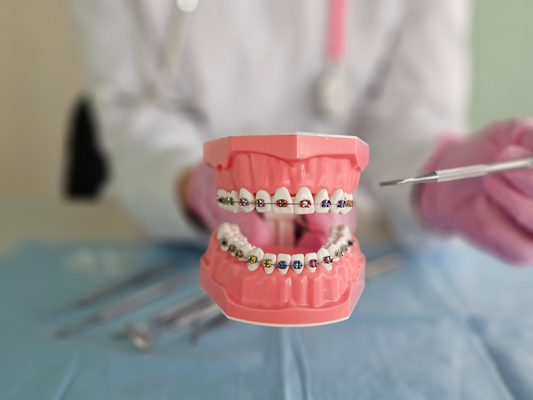
Adult orthodontics is not only for teenagers. More adults choose orthodontic treatment to straighten their teeth, improve their bite, and feel better about their smile. While clear aligners get most of the attention, metal braces remain a practical and reliable option in adult orthodontic treatment. Modern braces are smaller and less bulky than older versions and can address a wide range of orthodontic problems.
Why adults choose metal braces
There is no age limit on achieving a straighter, healthier smile. As long as the teeth, gums, and supporting bone are healthy, adults can often have successful orthodontic treatment. Metal braces may correct several common problems, such as:
- Crowded or overlapping teeth
- Gaps between teeth
- Crooked teeth
- Overbites
- Underbites
- Crossbites
Braces use brackets and an archwire to apply steady, controlled pressure to the teeth. At regular appointments, an orthodontist adjusts the braces to guide the teeth toward their planned positions. Unlike removable aligners, metal braces stay on the teeth throughout treatment. That can be helpful for patients who do not want to keep track of trays or remember to wear them for a set number of hours each day.
A good option for complex cases
One of the biggest advantages of metal braces is their versatility. They can handle simple alignment concerns as well as more complex cases that require significant tooth movement. The brackets and archwire give an orthodontist precise control over tooth position. Other components, such as elastic bands, can help correct bite problems when needed. This control makes metal braces a dependable choice for patients who need more than minor cosmetic changes.
Treatment time varies from person to person; the average time for adult patients is 18 to 30 months. A mild case may take less time, while a complex bite or alignment problem can require a longer treatment period. The orthodontist can provide a more realistic estimate after an exam and review of diagnostic images.
The functional and oral health benefits of metal braces
A straighter smile is a popular benefit, but orthodontic treatment can also improve everyday oral care. Teeth that sit in better positions may be easier to brush and floss, making plaque control simpler. Bite correction can also improve the way the teeth meet when chewing.
In some cases, orthodontic treatment may reduce uneven pressure on individual teeth and create a more balanced bite. These functional benefits are an important part of adult orthodontics. Treatment does not have to be purely cosmetic. For many adults, the goal is a combination of better appearance, easier dental care, and improved bite function.
Modern braces are more comfortable
The metal braces of today are not quite the same as the bulky appliances many adults remember from childhood. Brackets are smaller, wires are more refined, and treatment methods have improved. Some soreness is normal after the braces go on and after certain adjustments. In most cases, the discomfort is temporary. Orthodontic wax can also help protect the cheeks and lips from irritation as the mouth adjusts to the brackets.
Good oral hygiene matters throughout treatment. Brackets and wires create extra spaces where plaque and food can collect. Fortunately, regular brushing, careful flossing, and routine dental visits can help keep teeth and gums healthy while the braces do their work.
What treatment looks like for adults
Treatment usually starts with an orthodontic consultation. The orthodontist examines the teeth and bite and checks the health of the gums and supporting structures. Photos, X-rays, or other diagnostic records may also help with planning treatment.
Once the braces are in place, patients will need to attend follow-up appointments at regular intervals. During these visits, the orthodontist checks tooth movement and makes adjustments as needed. Keeping those appointments on schedule helps treatment stay on track.
There may also be a few changes to everyday habits. For example, hard or sticky foods can damage brackets and wires, so certain foods may need to stay off the menu. Cutting foods into smaller pieces can also make meals easier and reduce the chance of breaking the oral appliance.
Maintaining the results
The work does not stop when the braces come off. Teeth naturally can shift, particularly in the months after orthodontic treatment. Retainers help hold the teeth in their new positions. An orthodontist may recommend a removable retainer, a fixed retainer, or a combination of both. Retainer use can vary based on the individual case, so following the recommended schedule is important for patients to maintain their results.
Find the right orthodontic treatment for you
For patients who want a proven approach with predictable control, metal braces remain a solid choice in adult orthodontics. Do you have questions for the Precision Orthodontics & Pediatric Dentistry team? Call our Reston office today to learn more or schedule a consultation.
Request an appointment here: https://www.orthodonticprecision.com or call Precision Orthodontics & Pediatric Dentistry at (703) 391-8800 for an appointment in our Reston office.
Check out what others are saying about our services on Yelp: Adult orthodontics in Reston, VA.
Recent Posts
FastBraces® can help some patients straighten their teeth more quickly than traditional metal braces or even ceramic braces. This approach is designed to move the tooth crown and root more efficiently from the very start of treatment. A dental provider can explain how FastBraces works, whether it is a good fit for the patient’s case,…
You may know that Invisalign® is different than traditional braces, but you may not know all the reasons why. Both Invisalign and traditional braces straighten your teeth and correct other issues, but in very different ways. For many, Invisalign aligners are a great choice to straighten the teeth without visible brackets and wires. There are…
One question you may have is what you can eat and drink while using Invisalign®. Most people know that patients who get braces cannot eat and drink certain foods. People wonder if it is the same for Invisalign. One big potential detractor for many who want to straighten their teeth is feeling like they cannot…
One factor you may consider when deciding between Invisalign® and braces is the potential for mouth pain and cuts. You may have a lot of concern about discomfort when correcting the alignment of your teeth. Not only can there be discomfort from moving the teeth into place, but also the corrective device can rub the…